
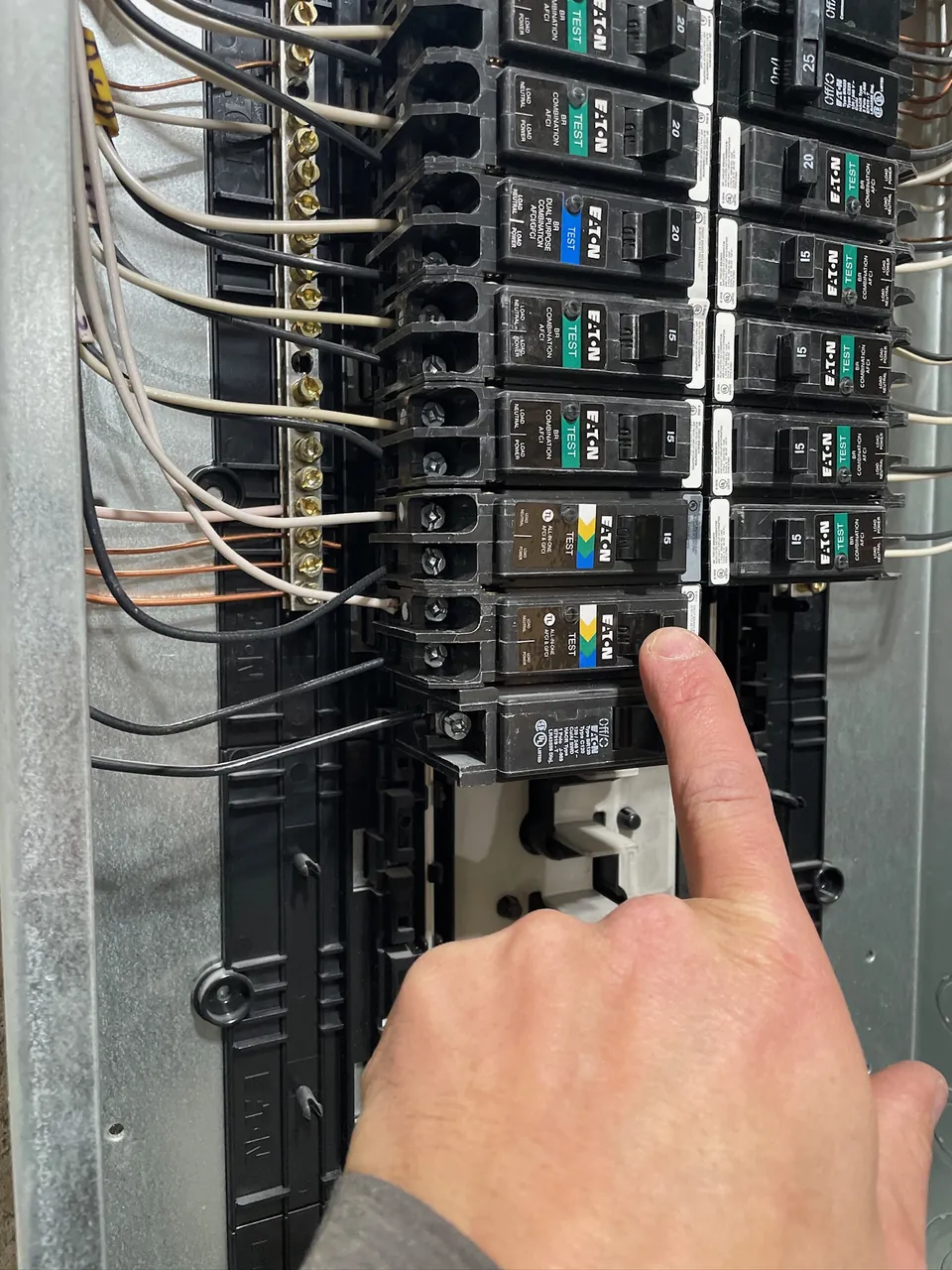
Level 2 circuits: 40, 50, or 60 amps
A Level 2 charger runs on 240 volts and needs its own dedicated circuit. The circuit size sets how fast the car charges. A 40 amp circuit supports a 32 amp charger, a 50 amp circuit supports 40, and a 60 amp circuit supports 48, because a continuous load like charging is limited to 80 percent of the breaker rating. For most drivers in the Quad Cities, a 50 amp circuit refills a day of driving overnight with hours to spare. We size the wire to the breaker and run it in conduit where it is exposed.
NEMA 14-50 receptacle or hardwired
A NEMA 14-50 receptacle lets you plug in a portable charger and take it with you if you move. It needs a GFCI breaker under the current code, and bargain receptacles fail under daily 40 amp loads, so we install an industrial-grade one. A hardwired charger skips the plug: the circuit lands directly in the unit, which allows the full 48 amps on a 60 amp circuit and avoids plug heating. It is also the cleaner install outdoors. We do both. Tell us the model you own, or ask before you buy and we will say what fits your panel.
100 amp panels and load management
Plenty of Prescott homes built before 2000 have a 100 amp service. Add an electric range, a dryer, air conditioning, and a 50 amp charger circuit, and the load calculation often comes up short. There are three honest ways through that. A smaller charger circuit, sometimes 20 or 30 amps, still beats a wall outlet by a wide margin. A load management device, or a charger that throttles itself when the house is drawing heavily, is allowed by the code as a way to fit a charger on a tight service. A 200 amp service upgrade is the right answer when more electric loads are coming anyway.
Rebates, plans, and what drives the cost
APS has offered Level 2 smart-charger rebates through its Marketplace, and it has off-peak charging plans that lower the cost of the electricity itself. Check the current terms before you buy, because eligibility is tied to specific models. The federal home charger credit has ended. On our side, the cost of the install comes down to distance and difficulty. A charger on the wall next to the panel is a short run. One on the far side of a detached garage is conduit, trenching, and maybe a subpanel. Circuit size, exterior mounting, and panel work to free a two-pole space also move the number.
When we would talk you out of it
- A driver who only covers a few miles a day: a 120 volt outlet on its own circuit may be enough, and we will say so.
- A panel that cannot carry any charger safely: we quote the service upgrade first rather than squeezing a circuit onto a maxed-out panel.
- Someone shopping for the charger itself: we install what you buy or suggest a model that fits, but we are not a dealer.
What you get
- Load calculation before we size the circuit
- 40 to 60 amp circuits with wire matched to the breaker
- NEMA 14-50 or hardwired, your choice
- Load management options for 100 amp panels
- Garage or exterior mounting in conduit
- Permit pulled and inspection passed
How it goes
- Step 1
Text us photos
Send a photo of the open panel and where the charger will hang, plus the charger model if you have one.
- Step 2
Load calc and quote
We confirm what the panel can carry, pick the circuit size, and send a written quote.
- Step 3
Install day
Circuit run in conduit, receptacle or charger mounted, breaker landed and labeled. Usually a half day.
- Step 4
Inspection and test charge
The inspector signs off, and we plug the car in to confirm the charger pulls its rated current.
Questions we get on the phoneStraight answers
Can I install a Level 2 charger on a 100 amp panel?
Often, yes, with limits. A load calculation decides it. Many 100 amp homes can take a 20 to 30 amp charger circuit, and a load management device lets a bigger charger share the service by throttling when the house is busy. If the numbers do not work, a 200 amp upgrade is the fix.
Should I get a NEMA 14-50 outlet or hardwire the charger?
Hardwire it if you want the full 48 amps, if the charger lives outdoors, or if you plan to keep it. Choose a NEMA 14-50 if you want to unplug the charger and take it with you. Either way we use a GFCI breaker where required and an industrial-grade receptacle.
Do I need a permit for an EV charger in Prescott?
Yes. A new 240 volt circuit requires an electrical permit in Prescott, Prescott Valley, Chino Valley, Dewey-Humboldt, and Yavapai County. We pull it and schedule the inspection. Permitted work is also what your insurer and the next buyer of the house will ask about.
Are there rebates for EV chargers in Prescott?
APS has offered charger rebates through its Marketplace for qualifying Level 2 smart chargers, and it has off-peak EV charging plans. Check the current terms, since eligible models change. The federal home charger tax credit has ended. We do not promise rebates, but we can help you pick a charger that qualifies.
Related
Where we do this work
EV Chargers across Prescott, Prescott Valley, Chino Valley and Dewey-Humboldt, with Williamson Valley and Paulden by appointment. See the full service area.