
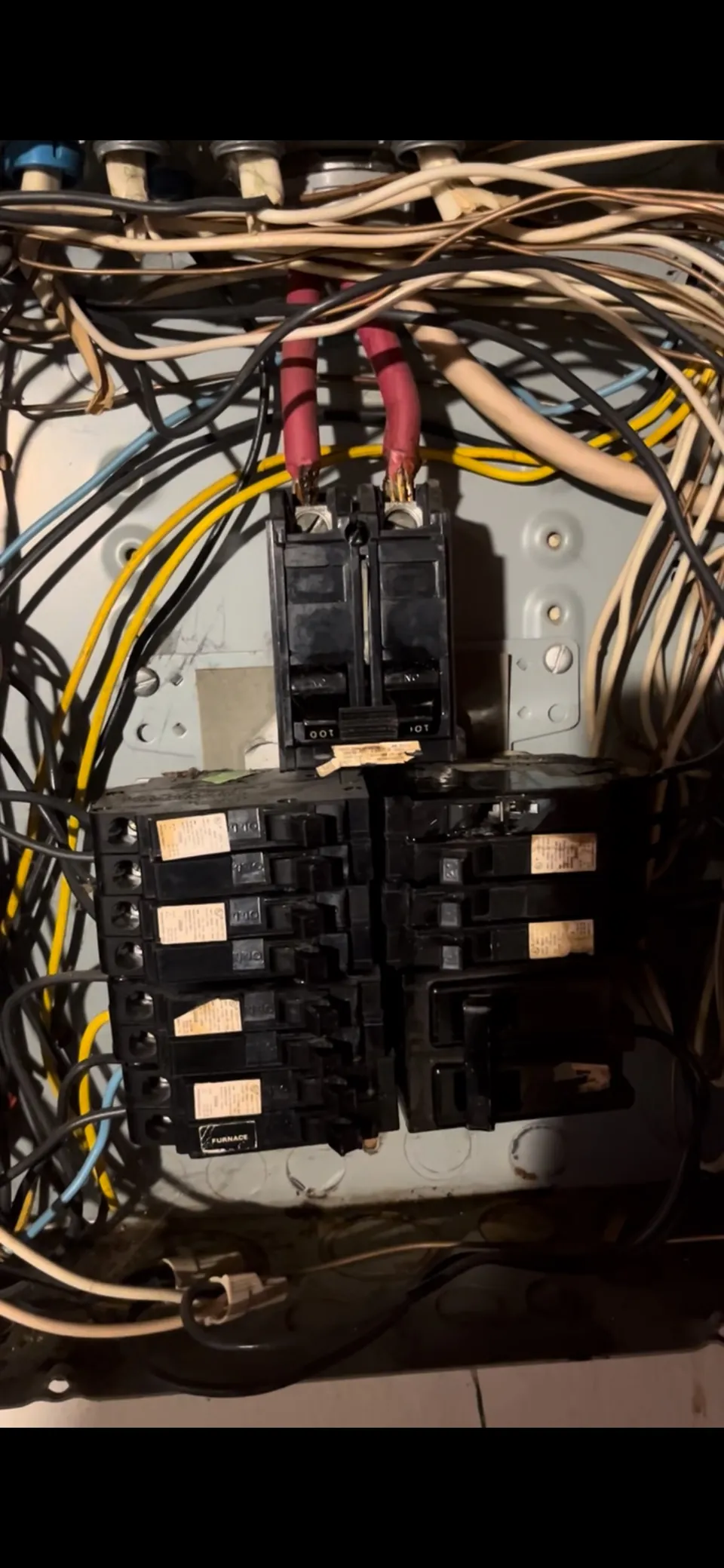
Tripping breakers and dead circuits
A breaker that trips once is doing its job. One that trips every week is telling you something: an overloaded circuit, a failing appliance, a nicked wire, or a breaker that has worn out. We start at the panel, check the wire size against the breaker, then trace the circuit with a meter until we find the load or the fault. Dead circuits are usually a tripped GFCI hiding in a garage or bathroom, a loose connection at a back-stabbed receptacle, or a failed splice in a box somewhere. We fix it at the source rather than running a new circuit around the problem.
Warm outlets, flickering lights, and loose neutrals
A warm cover plate, a buzzing switch, or a faint burning smell means heat at a connection that should not be there. Turn that circuit off at the panel and call or text us. Lights that dim when the air conditioner starts are often a normal voltage dip, but lights that flicker across the whole house, or brighten in one room while they dim in another, point to a loose neutral at the panel or the meter. That one is dangerous, because it can push 240 volts onto 120 volt circuits. We check the service neutral and the panel neutral bar first, then work outward.
Aluminum branch wiring remediation
Homes wired between 1965 and the mid-1970s may have aluminum branch circuits, the solid aluminum wire feeding outlets and lights. It works until the connections loosen. The CPSC found that pre-1972 homes with aluminum wiring are 55 times more likely to reach fire-hazard conditions at a connection. The full fix is a copper rewire. The practical fix is remediation: at every device, we splice a short copper pigtail to the aluminum with an approved connector, then land the copper on a new device. Ordinary wire nuts and back-stabbed devices are not acceptable on aluminum. We quote by the device and document the work for your insurer.
What drives the cost of a repair call
Troubleshooting is priced by time, and time depends on how hidden the fault is. A tripped GFCI in a garage takes minutes. A dead circuit that turns out to be a failed splice above a finished ceiling takes longer to find than to fix. Aluminum remediation is priced by device count. Access matters: crawlspaces, attics in summer, and finished walls slow things down. The age of the panel matters too, since a repair on a Federal Pacific or Zinsco panel often turns into a conversation about replacing it. Text us a description and a photo and we will say what to expect.
When we would talk you out of it
- A whole-house rewire: if every circuit needs replacing, that is a bigger project than a repair call, and we will refer you to a crew set up for it.
- A failing appliance: if the breaker trips only when the dryer or the range runs, the appliance is usually the fault, and an appliance tech is the cheaper visit.
- A Federal Pacific or Zinsco panel with a bad breaker: we will not source a used breaker for a panel we would not put our name on.
What you get
- Diagnosis with a meter before anything is replaced
- Loose neutrals and heat at connections found at the source
- Aluminum wiring remediated with approved connectors
- Back-stabbed devices replaced with screw-terminal ones
- Photos and a plain explanation of what we found
- Honest call when a repair should be a panel job instead
How it goes
- Step 1
Describe the symptom
Call or text us what is happening, when it started, and a photo of the panel if you can.
- Step 2
Diagnose
We test at the panel and trace the circuit until we find the cause, then explain it.
- Step 3
Repair
Most repairs are finished the same visit. Bigger ones get a written quote first.
- Step 4
Verify
We load the circuit, confirm the fix, and leave you photos of the work.
Questions we get on the phoneStraight answers
Why does my breaker keep tripping?
The usual causes are an overloaded circuit, a failing appliance, a ground fault, or a breaker that has worn out. If it trips when a specific appliance runs, suspect the appliance. If it trips with nothing on, suspect the wiring or the breaker. We test at the panel and trace the circuit.
Why is my outlet warm?
Heat at an outlet means resistance at a connection: a loose wire, a back-stabbed terminal, or a worn receptacle that grips the plug poorly. In homes from the 1960s and 1970s it can also mean aluminum wiring at the device. Turn the circuit off at the panel and call or text us.
Do I have to rewire aluminum wiring?
Not necessarily. A full copper rewire is the most complete fix, but remediation at every device with approved connectors is accepted by the CPSC and by many insurers. We pigtail copper to the aluminum at each outlet, switch, and fixture, replace the devices, and document the work.
Why do my lights flicker when the AC starts?
A brief dim when a compressor starts is normal; the motor pulls a big inrush current. Flickering that continues, spreads through the house, or makes some lights brighter while others dim is a different problem, often a loose neutral. That one can damage appliances, so we diagnose it the same visit.
Related
Where we do this work
Repair and Troubleshooting across Prescott, Prescott Valley, Chino Valley and Dewey-Humboldt, with Williamson Valley and Paulden by appointment. See the full service area.