
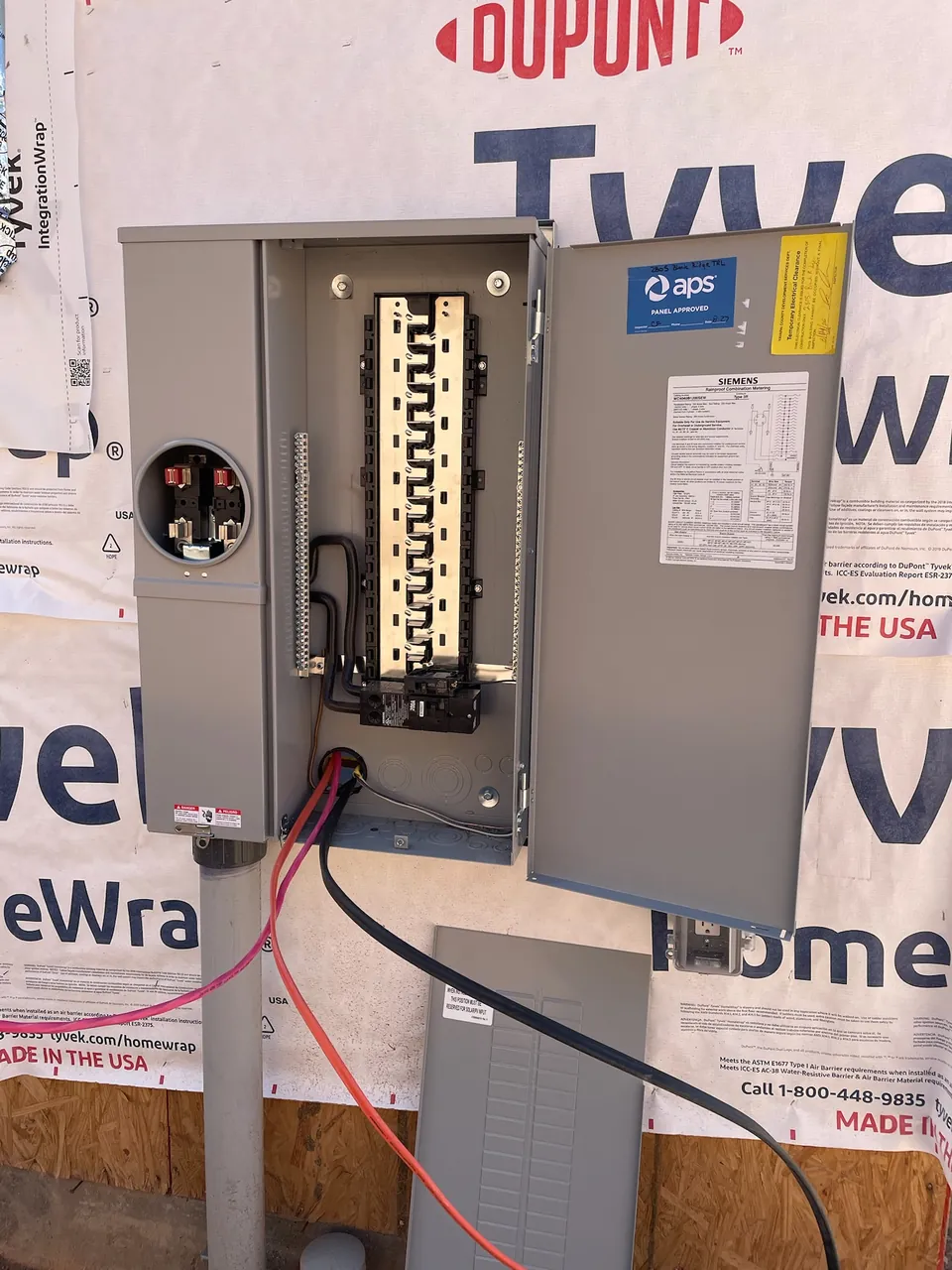
What a service upgrade includes, overhead or underground
The service is the equipment on the utility side of your panel that belongs to you. On an overhead service it starts at the weatherhead and mast where the APS drop attaches, runs through the meter socket, and ends at the main disconnect. Rusted masts and cracked weatherheads get replaced as part of the job. On an underground service, common on homes built after 2000, the conductors come up in conduit from the APS pedestal instead. Most upgrades use a meter-main combination: one outdoor enclosure holding the meter socket and the main breaker, feeding the interior panel as a subpanel.
200 amp or 400 amp
A 200 amp service covers most houses in the Quad Cities, including ones with a heat pump, an EV charger, and a hot tub. We recommend 400 amps when the load calculation says 200 will not carry it: a large all-electric home, a shop with welders, a second dwelling on the property, or two EV chargers plus electric heat. A 400 amp residential service is usually a 320 amp continuous meter socket feeding two 200 amp disconnects. It costs more in conductors and equipment, and APS may need to change their equipment on the pole. Nobody needs 400 amps because a neighbor has it.
APS coordination and the county PE-4 release
APS owns the meter and the lines to the house, so every service upgrade is scheduled around them. Inside Prescott, Prescott Valley, Chino Valley, and Dewey-Humboldt, the town inspects the new service and notifies APS to reconnect. Unincorporated Yavapai County addresses in Williamson Valley, Walker, Groom Creek, and Paulden follow county policy PE-4: we schedule the upgrade inspection, the inspector tags the service for release, the county emails the release to APS, and a final inspection follows. We build that sequence into the schedule so the house is not sitting dark waiting on paperwork.
What drives the cost of a service upgrade
Amperage is the biggest factor. A 400 amp service needs larger conductors, a bigger meter socket, and two disconnects. Overhead versus underground matters, since a new mast is a different job from trenching new conduit. Condition counts too: a meter socket set into stucco that has to be cut back and patched costs more than one on siding. Replacing the interior panel at the same time, and the length of the feeder to reach it, both move the number. Any changes APS makes to their own equipment happen on the utility's schedule and terms.
When we would talk you out of it
- A house whose service is sound and rated for the load: a panel replacement alone is the cheaper job.
- Someone who wants 400 amps on a hunch: if the load calculation says 200 amps carries the house with margin, we say so and quote 200.
- A property where APS has to change their own equipment first: that runs on the utility's schedule, and we tell you before you commit to a date.
What you get
- Meter socket, mast, and conductors sized for the new load
- Meter-main combination with a proper outdoor disconnect
- APS coordination and the county PE-4 release handled
- Grounding and bonding brought up to the current code
- Interior panel replaced or converted to a subpanel
- Permit and inspection on every service upgrade
How it goes
- Step 1
Text us photos
Send a photo of the meter, the mast or where the service enters, and the open panel.
- Step 2
Load calc and scheduling
We size the service, file the permit, and line up the APS disconnect and reconnect.
- Step 3
Upgrade day
Meter pulled, old equipment out, new meter-main and conductors set, grounding corrected, inspection called.
- Step 4
Release and reconnect
The inspector releases the service, APS reconnects, and we walk you through the new disconnect.
Questions we get on the phoneStraight answers
How long is the power off for a service upgrade?
Usually one working day, occasionally into the next morning. APS disconnects, we replace the meter socket, mast or conductors, and the disconnect, the inspector releases it, and APS reconnects. In unincorporated Yavapai County the PE-4 release adds an email step, so we start early.
Do I need a service upgrade to add an EV charger?
Not always. Many 200 amp services have room for a 40 or 50 amp charger circuit. A 100 amp service often does not, and a load calculation tells us which case you are in. If the service is undersized, a 200 amp upgrade is the clean fix and a load-managed charger is the workaround.
What is a meter-main combo?
A single outdoor enclosure holding the APS meter socket and the main breaker together. It gives the house a service disconnect outside, which the current code calls for on new and replaced services, and it feeds the interior panel as a subpanel. It is how we build most 200 amp upgrades.
Can an overhead service be converted to underground?
Yes, when APS has an underground source nearby. Converting means trenching conduit from the APS pedestal to a new meter socket, and APS sets the terms on their side. On streets served only by overhead lines, we replace the mast and drop and keep it overhead.
Related
Where we do this work
Service Upgrades across Prescott, Prescott Valley, Chino Valley and Dewey-Humboldt, with Williamson Valley and Paulden by appointment. See the full service area.