
By Josh Fuller · September 25, 2026 · Repair and Troubleshooting
Aluminum Wiring in 1970s Prescott Homes: How to Tell and What to Do
In short: Homes wired between 1965 and the mid-1970s may have aluminum branch circuit wiring, and in Prescott that lands on the late end of the 1940 to 1969 stock and the early end of the 46 percent of homes built from 1970 to 1999. The risk is at the connections, not in the wire itself, and a new panel does not fix it. The accepted repairs are a copper rewire, COPALUM crimps, or approved connectors at every termination in the house.
In short: Homes wired between 1965 and the mid-1970s may have aluminum branch circuit wiring, and in Prescott that lands on the late end of the 1940 to 1969 stock and the early end of the 46 percent of homes built from 1970 to 1999. The risk is at the connections, not in the wire itself, and a new panel does not fix it. The accepted repairs are a copper rewire, COPALUM crimps, or approved connectors at every termination in the house.
Which Prescott-area homes are in the window
Copper got expensive in the mid-1960s and builders switched to aluminum for the small 15 and 20 amp branch circuits that feed lights and receptacles. By the mid-1970s the problems were known and the practice ended. So the window is roughly 1965 to 1975, with 1972 as the year the CPSC uses as a dividing line in its data.
Prescott’s housing stock has plenty of homes in that window. About 13 percent of the city was built between 1940 and 1969, and 46 percent between 1970 and 1999. The homes from the late 1960s through about 1975 are the ones to check, and they sit in the established neighborhoods rather than the newer subdivisions. Prescott Lakes, built from about 2000, is not in the window. Nothing built after the late 1970s should have it. Our Prescott service area page breaks the housing down by era.
Dewey-Humboldt is the other place we expect to find it. The Prescott Country Club area, laid out around the public course built in 1971, is the 1970s core of the town, and 53 percent of Dewey-Humboldt’s homes date from 1970 to 1999. The early part of that range is the aluminum era. If you own a 1971 to 1975 home near the course, it is worth a look, and our Dewey-Humboldt service page covers the town’s housing in more detail.
Why it is a problem
The CPSC has studied this for decades, and the number that matters is this: homes wired with aluminum before 1972 are 55 times more likely to have one or more connections reach fire-hazard conditions than homes wired with copper. That is a CPSC figure, not ours.
The wire itself carries current fine. The failures happen where the wire is terminated: the screw on a receptacle or switch, the wire nut in a junction box, the lug on a breaker. Aluminum expands and contracts more than copper as it heats and cools, so a screw terminal that was tight in 1972 works loose over thousands of cycles. Aluminum also oxidizes, and aluminum oxide does not conduct. A loose, oxidized connection has resistance, resistance makes heat, and heat loosens it further. The endpoint is a charred receptacle behind a cover plate.
Old aluminum wire is also softer than the alloy used today, which is why the crimp and connector repairs exist. They clamp the wire in a way a screw terminal cannot.
How to tell what you have
You do not need to open anything to get a strong hint. You do need to open the panel door and a cover plate or two to be sure.
At the panel
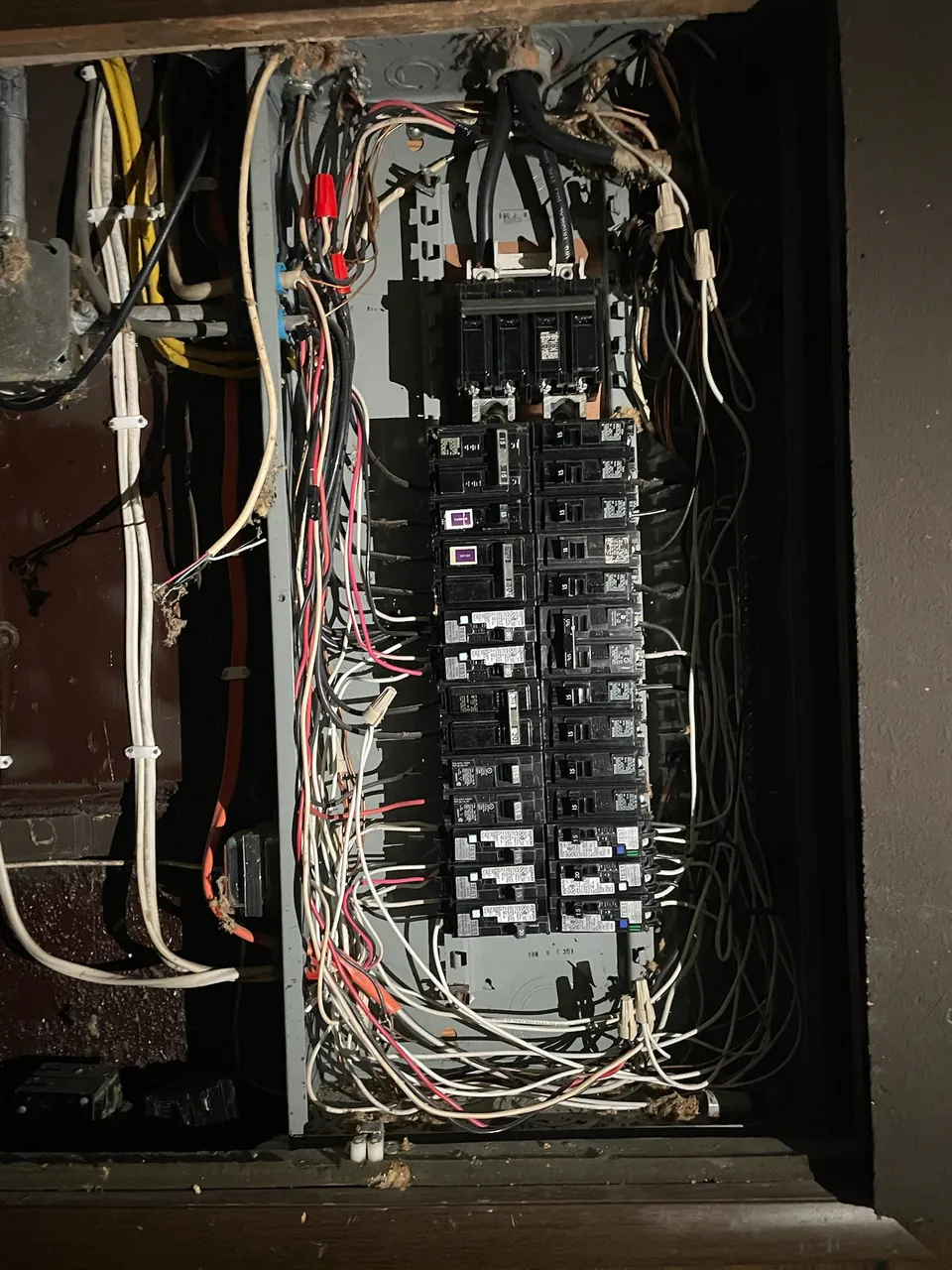
Open the outer door. Look at the wires landed on the breakers. Copper is orange-red. Aluminum is dull silver. Then look at the cable jackets where they enter the panel. Aluminum-conductor cable from that era is printed with “AL” or “ALUMINUM” on the jacket every couple of feet. If the panel is 1965 to 1975 vintage and the branch wires are silver, that is aluminum branch wiring.
Do not confuse it with the large aluminum service conductors feeding the main breaker, which are normal and still used today. The concern is the small 15 and 20 amp branch circuits.
At the outlets and switches
Warm cover plates are the classic sign. Put a hand on a few receptacle and switch plates while things are running. Any that feel warm, or any that are discolored or have a faint plastic smell, are a termination that is heating. Lights that flicker when nothing is being switched, a receptacle that works some days and not others, and a breaker that trips without an obvious cause are all consistent with a failing aluminum connection.
Signs of a previous repair
If someone has been in the boxes before, you may see purple twist-on wire nuts joining a short copper pigtail to the aluminum wire. Those purple connectors are sold for aluminum-to-copper splices, but the CPSC does not consider ordinary twist-on connectors an accepted repair for aluminum wiring. If that is what a previous owner did, the house has a partial fix and the terminations still need to be done properly.
This is not a panel problem
We replace panels for a living, so this is worth saying plainly: a new panel does nothing for aluminum branch wiring. The hazard is at every receptacle, switch, light, and junction box in the house, and the panel touches none of those. Anyone who sells you a panel replacement as the fix for aluminum wiring has sold you the wrong job.
Sometimes both are needed. A 1972 house with aluminum branch circuits often also has a Federal Pacific or Zinsco panel, and that panel should come out for its own reasons. But the two jobs are separate, priced separately, and permitted separately. Our panel upgrade page covers the panel side. The rest of this post is about the wiring.
The accepted repairs
The CPSC recognizes two repairs as complete, and a third approach is listed and widely used.
Copper rewire
Pull new copper cable to every circuit and abandon the aluminum. This is the only repair that removes the aluminum from the house, and it is the most work. In a single-story home with an accessible attic it is more practical than it sounds. In a two-story or slab home with finished ceilings it can mean drywall repair. It is the answer when the house is being remodeled anyway.
COPALUM crimp
A short copper pigtail is joined to each aluminum conductor with a metal sleeve crimped under very high pressure by a specific tool, then insulated. The crimp is a cold weld and it does not loosen. This is the repair the CPSC calls permanent alongside rewiring. The tool and the training are controlled by the manufacturer, so not every electrician can offer it, and it is done at every termination in the house.
Approved connectors at every termination
A listed setscrew connector joins a copper pigtail to the aluminum wire inside each box, and the copper pigtail lands on the device. The connector clamps the aluminum under a screw with a rated torque, in a housing designed for the two metals. This is the approach most often used in practice because it does not need the crimp tool, and it is a listed method. The key words are “every termination”: doing the kitchen and skipping the bedrooms leaves the hazard in the bedrooms.
Swapping receptacles and switches for CO/ALR-rated devices addresses only the device screws and does not count as a repair of the system.
What we do on an aluminum wiring call
The first visit is a troubleshooting and inspection call, not a sales call. We open the panel, confirm the conductor material, open a sample of boxes across the house, and count the terminations. That count is what a written scope is built on, because the job is priced by the number of connections, not by the square footage.
We then lay out the choices in writing: connectors at every termination, a rewire, or the crimp option where available, and what each means for your walls and your schedule. If the panel is also a bad brand, that goes on the same sheet as a separate line. And if the house turns out to have copper with a few aluminum feeders to the range and dryer, which is common and normal, we say so and you have spent one visit finding out.
A home from the aluminum era is worth checking before the sale, before the remodel, and before the next warm cover plate. Text us photos of the open panel and the meter, and we will tell you what you are looking at and send a written estimate for the next step.
Want us to look at your panel?
Text photos of the open panel and the meter. Written quote within one business day, permit included.
Related questionsStraight answers
How do I know if my house has aluminum wiring?
Open the outer panel door and look at the wires on the breakers: copper is orange-red, aluminum is dull silver. Cable jackets from the era are printed with AL or ALUMINUM. Warm or discolored cover plates and flickering lights are the symptoms at the devices. Homes wired from 1965 to the mid-1970s are the ones to check.
Does a new electrical panel fix aluminum wiring?
No. The hazard is at the connections in every receptacle, switch, and junction box, and a panel replacement touches none of them. The two jobs are separate. A 1970s home may need both, since these houses often have a Federal Pacific or Zinsco panel as well, but the panel is priced and permitted on its own.
Is aluminum wiring dangerous?
At the connections, yes. The CPSC found that homes wired with aluminum before 1972 are 55 times more likely to reach fire-hazard conditions at one or more connections than copper-wired homes. The wire carries current fine; the failures are loose, oxidized terminations that heat up. Repairing every termination removes the hazard.
Do I have to rewire the whole house?
Not necessarily. A full copper rewire is one accepted repair and the only one that removes the aluminum. The others, COPALUM crimps and approved connectors, add a copper pigtail at every termination and leave the aluminum in the walls. All three are done at every connection in the house; a partial repair leaves the hazard wherever it was skipped.
Are the purple wire nuts an acceptable fix for aluminum wiring?
No. Purple twist-on connectors are sold for aluminum-to-copper splices, but the CPSC does not consider ordinary twist-on connectors an accepted repair. The accepted repairs are a copper rewire, COPALUM crimps, or listed setscrew connectors at every termination. If a previous owner used purple wire nuts, treat the house as unrepaired and have the terminations redone.